


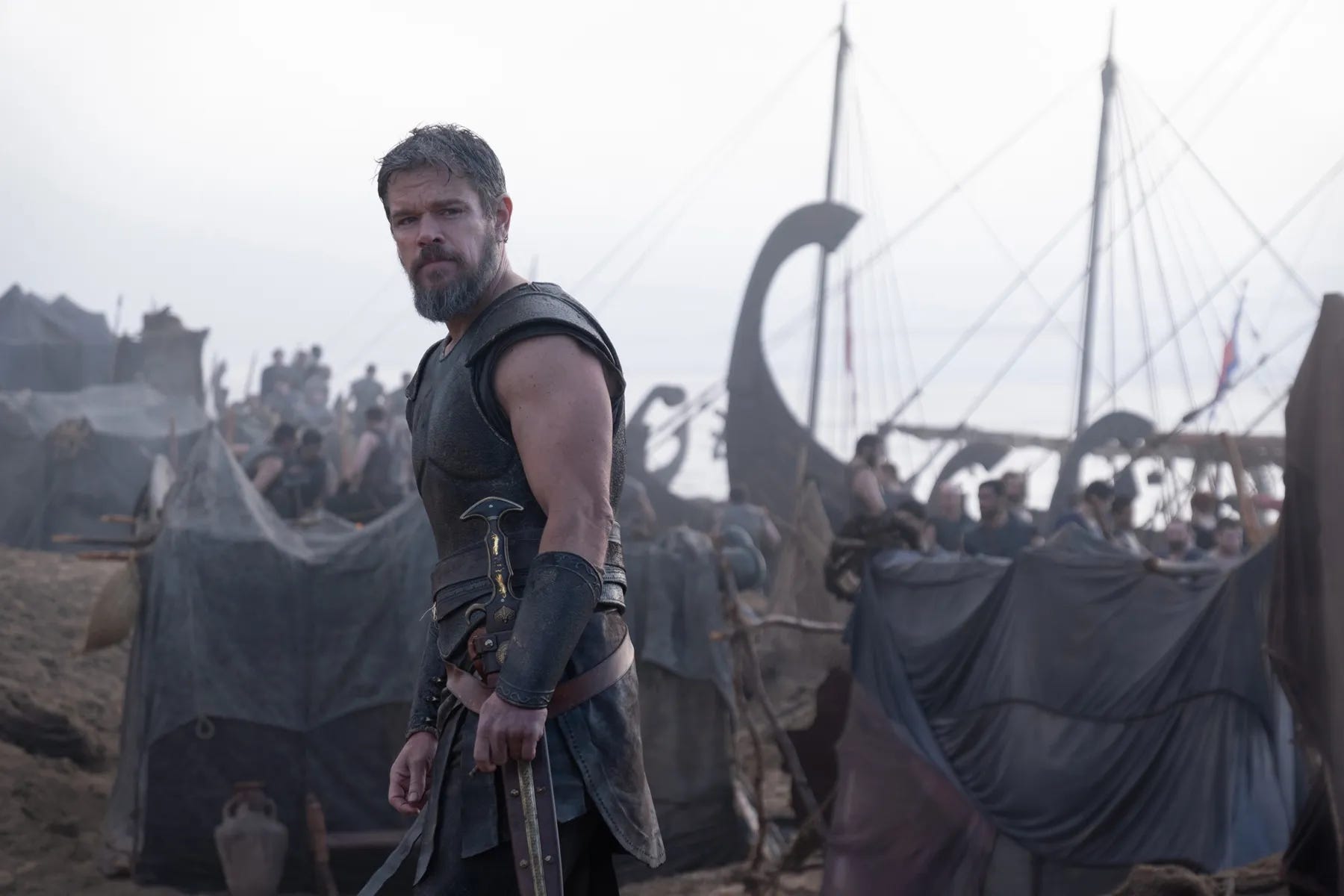
The Odyssey is the defining film of the summer, the year, and Christopher Nolan’s career.
My esteemed colleagues at Cinemantics criticized the film when it first came out, arguing that the removal of the gods from the story and the humanist focus of the film’s tone sapped the story of its timelessness. They’re not alone. Translator Emily Wilson had similar critiques of Nolan’s adaptation, criticizing it for being full of nothing more than Nolan’s “usual combination of grandiosity and superficiality.”
Those are not fully unfair criticisms. The Odyssey is through-and-through a Christopher Nolan movie, full of his thematic preoccupations, signature nonlinear style, and rapid editing.
But it also presents a thematic climax to Nolan’s two-and-a-half decade career, putting the stamp on his career to this point.
For a story with such iconic, cinematic moments, The Odyssey is a deceivingly tricky work to adapt. Nolan’s decision to adapt the poem seemed both like a massive creative risk, and a natural fit for the director.
A risk because no filmmaker had tackled the full story of The Odyssey before (Coen Brothers musicals aside). The big moments ingrained in popular consciousness — the cyclops, Scylla and Charybdis, Circe turning Odysseus’s men into pigs, the Lotus Eaters — take up a relatively small portion of the story. These events are confined to a couple of books in the epic. Instead, large portions of Homer’s poem tell of the events that transpire in Ithaca, where Penelope fends off various suitors vying for her hand, while the rest of the story is relayed by one character to another. And the poem contains numerous sequences, such as a fight where Odysseus kills a homeless man, or Odysseus cheating on his wife for extended periods of time, that would be alienating to a modern audience.
But it was also a natural fit because Nolan has been drawing on the major themes of The Odyssey for his entire career. And with his adaptation, he brings two of those major themes to their thematic climaxes, providing a stunning capstone to the director’s career.
Two major threads in Nolan’s storytelling are the trope of characters returning home, and the trope of characters lying to uphold a larger structure, but in doing so, causing their world to collapse.
The act of returning home is often what resolves a central conflict or incites a heroic arc for the characters. In Interstellar, humanity is saved because Cooper makes the decision to return home to Earth to see his daughter. Cobb’s entire motivation in Inception is to return home to see his children. The film concludes with him walking away from the spinning top, indifferent to whether he’s in a dream or in reality because he finally feels that he’s home. Bruce Wayne’s heroic arcs during the first act of Batman Begins and the third act of The Dark Knight Rises are kickstarted by his return to home in Gotham.
This theme is most evident in Dunkirk, where the act of surviving and returning home is the ultimate achievement of the characters in the movie. The film repeatedly emphasizes how close home, England, is to the characters, just over the horizon but out of reach. The film’s central emotional arc resolves by bringing home across the English Channel to Dunkirk to save the British army. When the British leaders see the ships amassed to evacuate the soldiers, in response to the question, “What do you see?” Kenneth Branagh’s character responds, “Home.”
Nolan’s characters are also constantly lying for a greater cause that ends up jeopardizing their worlds. Batman and Gordon choose to lie about Harvey Dent’s crimes at the end of The Dark Knight, and in doing so, lay the groundwork for Bane’s takeover of Gotham in The Dark Knight Rises. In Memento, Leonard lies to himself about his wife’s death to give himself a purpose, to hunt down his wife’s purported killers, causing him to live a lie in perpetuity. In Insomnia, Will Dormer’s lies about his partner’s death end up entangling him with the antagonist and lead to his death. Cobb lies to his team about Mal in Inception, nearly destroys the mission, and consigns Saito to a life in limbo. Borden lies to his wife about his dual nature in The Prestige; Dr. Brandt lies to his entire world, including his daughter, to motivate them to try to save humanity in Interstellar. Oppenheimer’s rationalizations for his work on the Manhattan Project are constantly shifting as he tries to justify his role in the creation of the atomic bomb.
Odysseus is, after all, a “complicated” man, a man of “twists and turns,” whose trick about the Trojan horse wins the Trojan War for Greece. Nolan has always been a very humanist storyteller. Interstellar’s central revelation is that the advanced beings who create the tesseract that saves humanity aren’t some alien species, they’re future humans. We are the ones who will save ourselves.
That faith in humanity is rewarded in Nolan’s Batman films, as Batman tells the Joker at the end of The Dark Knight when the ferries fail to blow each other up, “This city is full of people ready to believe in good.” Dunkirk is about the power of ordinary people to simply survive a great trauma, and for that to be enough. “All we did was survive,” a soldier tells an old man at the end of the film. “That’s enough,” the old man responds.
Nolan’s films are never myopic in his storytelling. The soldiers in Dunkirk who survived are likely the ones to head right back out to fight in the war’s next battle. Gotham is a city that has grown decadent and its people easily susceptible to a populist revolution in The Dark Knight Rises. Huge portions of the human race die in Interstellar because of the climate apocalypse, both Cobb and Leonard are comfortable to live in lies at the end of their respective stories.
Indeed, Tenet suggests something far darker about humanity: that future generations will look back on the present generation as an abject failure and will try to destroy it from the future. Oppenheimer directly reckons with a man who gave humanity the ability to destroy itself, and remarks at the end of the film that he believes he started the chain reaction that will destroy the world.
As my colleagues argued, Nolan’s adaptive decisions in The Odyssey strip the story of some of its otherworldliness. They make the film more distinctly a Nolan project and flip these two ideas on their heads.

Nolan focuses on one of the dominant themes of The Odyssey – the importance of norms and hospitable respect for strangers – to tell a story about violations of those exact norms, and what happens when those charged with upholding those norms are the very ones who tear them down. It’s a film about the consequences of deception, corruption, and moral compromise.
“A structure is nothing without people’s respect for its meaning,” Anne Hathaway’s Penelope tells Tom Holland’s Telemauchus at the beginning of the film. We are introduced to the palace of Ithaca on its last legs after its ransacking by suitors vying for Penelope’s hand. These suitors, we are told, are not just stealing food and drink. They’re abusing a long-cherised norm, Zeus’s Law, that strangers are to be welcomed and treated well because they may be gods in disguise.
But as the movie reveals, Odysseus’s original sin, the first violation of Zeus’s Law in his story, is his deception about the Trojan Horse. It’s his first breaking of the social compact that formed the backbone for his world. He says that by using the horse, a “gift for Athena,” as one Trojan soldier describes it, he “broke all that was sacred between men.” Everything in the story is a consequence of Odysseus’s deception, which prompts the massacre of the Trojans.
Sinon — a character who does not appear in either of Homer’s epics — hammers home this point. Odysseus does not tell Sinon about the trick of the horse, but instead leaves him with the horse as a gesture of goodwill to the Trojans, a gesture that immediately gets Sinon killed. Odysseus tells himself that this is the best for Sinon, that his sacrifice is worth it for the greater good.
The inclusion of Sinon is one of Nolan’s best adaptive changes. It humanises the gravity of Odysseus’s crime. He unleashes “ten years of rage” on Troy in one night. He fails to protect a young boy entrusted to him. His lie breaks his own world, and the entire world of the story. His Greeks are also revealed to be the “Sea Peoples,” wreaking havoc on communities across the Mediterranean on their way back to Ithaca, unknowingly exacerbating the collapse of the social compact.
The revelation that the “Sea Peoples” are the threat that’s pushing Greek cities to arm themselves and prepare for war is a very Nolanian twist. That the source of that threat is the Greeks themselves is Nolan inverting the reveal from Interstellar. We are our salvation, but we are also our own greatest threat. Odysseus’s lie of the horse is what prompts the Greeks to become the Sea People, as he can’t bring himself to return home to face what he’s done. Where in Interstellar, the only ones who can save humanity are humans themselves, in The Odyssey, the Greeks are the ones causing the downfall of their own civilization.
The Sirens’ song reveals an inversion of another of Nolan’s major themes. “It was a song of all the promises I failed to keep. And it told me I don’t really want to go home,” Odysseus says of the song. Odysseus admits to himself that he does not want to go home because he can’t face the consequences of what he’s done. Nolan’s other protagonists are typically driven to return home to resolve the story. Odysseus delays his return, resulting in the deaths of his men and the continued breaking of Zeus’s Law.
The depiction of Odysseus as guilt-ridden may seem at odds with much of the poem’s Odysseus. But it’s not completely out of place. In Book 8 of Homer’s epic, when a bard tells the story of the fall of Troy, Odysseus weeps at the recounting. It’s ambiguous as to whether he’s weeping because of his role in the violence, or because of the loss of his comrades, but such a clear display of emotion indicates some level of guilt at Odysseus’s role in the massacre of the Trojans.
When Odysseus finally does return home, he finds a broken society. This is, admittedly, a weakness in Nolan’s adaptation. We never actually see anything of Ithacan society to inform us about the kingdom that Odysseus rules. Nolan focuses exclusively on the palace and the immediately surrounding hills, so we never have a sense of what Ithacan society is actually like.
Still, Odysseus must right Ithaca through a bloody expiation. His massacre of the suitors feels like a triumphant note to end the story on, but he concludes his arc by sending himself into exile to go into the unknown West, “chasing the escaping sun,” to pay honor to the men he lost. He departs the world, handing over his rule to the next generation, who he can only hope will do better.
The Odyssey is an incredible feat of adaptation, one rife with stunning set-pieces and performances that will live on in popular culture (as some already have). And the discussions the film has prompted have been great to experience. The film has clearly struck a nerve with audiences, as the box office returns indicate. Its rejuvenation of the IMAX format shows that audiences still love the theatrical experience.
Nolan is the most powerful director in Hollywood and will continue to have blank checks to make whatever projects he desires. The Odyssey feels like a film by a director who wanted to bring his major preoccupations to thematic climaxes, and who wanted to reckon with the darker sides of those ideas. Like many Nolan stories, it ends with a superficially satisfying ending, but suggests that the next generation is consigned to repeat the mistakes of the older generation.
The violations of norms will not be easily corrected. Lies that break the world are hard to undo. As one of Nolan’s most iconic characters says, “There’s no going back. You’ve changed things. Forever.”
Hold on, someone adapted The Odyssey? I had no idea! I had just been watching The Sheep Detectives twice a day, seven days a week since mid-May.