


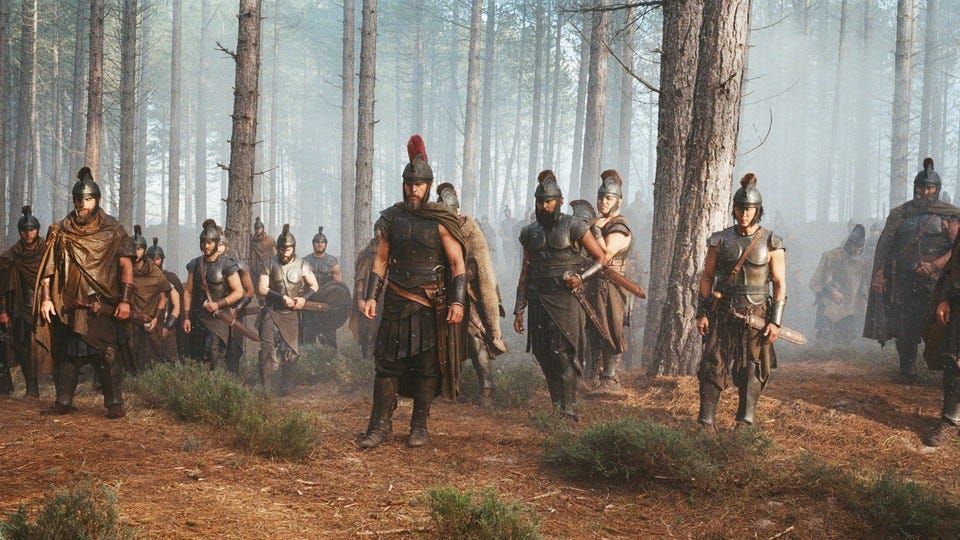
We enjoyed The Odyssey.
It was a big-budget spectacle that rivals the greatest of twentieth-century epics. Always entertaining, never boring. Writer-director Christopher Nolan deserves credit for the boldness of taking on one of the greatest epics in human history and pushing the limits of his own filmmaking.
This was an enormous undertaking, and he did an incredibly good job of making the film entertaining and visually stunning. It especially pays off in the final third, as the sacking of Troy and the vengeful return of Odysseus collide in spectacular Nolan fashion. The acting from a commanding Anne Hathaway and a deeply disturbing Samantha Morton is particularly strong.
It’s the type of movie that demands to be seen in the cineplex. And audiences have agreed. Grossing a truly monumental $123 million domestically on its opening weekend, it's important to celebrate the fact that over half of the audience chose to watch it on a premium screen, yours truly and the Cinemantics gang included. (We drove several hours and crossed state lines to see it in IMAX 70MM).
Now comes the hard part. We must stand athwart history and say that we didn’t love it. Nor did we like it. We just enjoyed it—and there’s a single reason why. One that starts as early as the first image on screen.
A title card with declarative text in a deep blue: “It is a time of apparent magic.”
It is the Rosetta Stone for Nolan’s take on the material. Apparent magic. A world where the characters' worldviews and mores are shaped by divine beings we never see, working through naturally occurring phenomena those in the twenty-first century would downplay as mere science. A world where only humans are the masters of their fates. Adapting a foundational epic about gods and monsters, there are no gods and the monsters are middling, the least interesting part of the story Nolan tells.
Every substantive praise of the film hinges on the title card. We’ve seen it already. Much ink will be spilled by commentators and Letterboxd reviewers as they trip over themselves to praise Nolan’s humanistic take on the oldest piece of Western literature. They’ll bend over backward to justify the Oscar-winner’s decision to strip the epic fable of its mythic elements. They’ll chastise those who wished to see the Greek gods depicted and the wrath they rain down on the hubristic king of Ithaca. “It’s Nolan,” they’ll say. “You’d be silly to assume that the man who made Oppenheimer and The Dark Knight would go the way of high fantasy!”
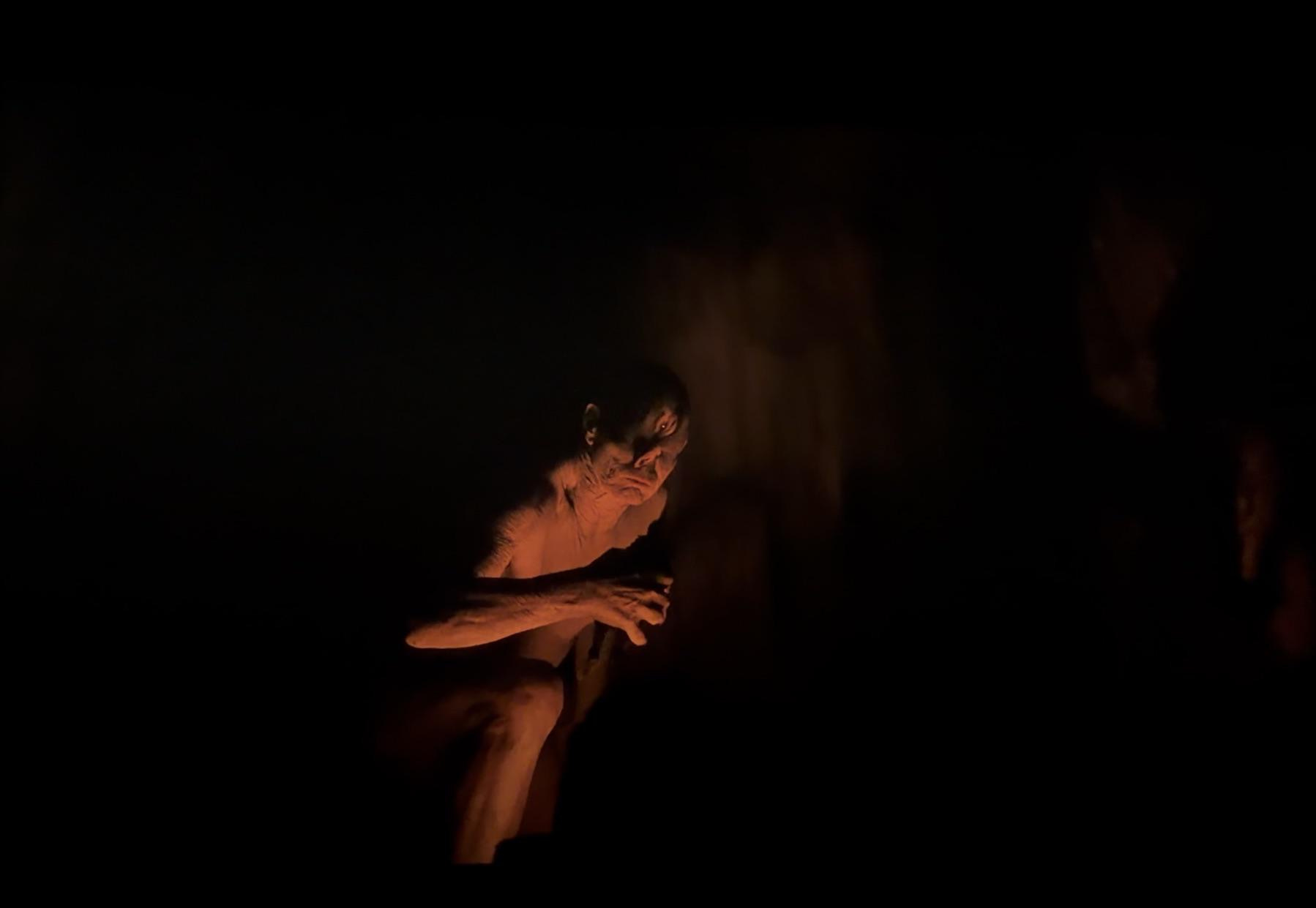
Every substantive criticism rests on that title card, too. Downplaying this critique does the movie and Nolan’s message a disservice. While entertaining, Nolan’s The Odyssey deprives the source material of the magic, spirituality, and transcendence embedded in the original epic and in all great stories. In doing so, it becomes merely an entertaining adventure for our current moment. Not for all time.
In recontextualizing the collapse of the Bronze Age as the direct consequence of a single person's cunning, ego, and deception, Nolan appears to be drawing parallels between the fall of Troy and the current cultural moment. We feel a similar sense of chaos. Norms are being violated, violence appears to be everywhere, and there is a growing sense of darkness on the horizon. The fall of Troy led to one of the darkest ages in human history. Despite the near collapse of civilization, humanity persisted.
This is a theme Nolan explores frequently. He trusts humanity to endure the consequences of its darkest actions, the chaos it creates through its own lies, violence, and mistakes. In reckoning with the historic implications of the Trojan Horse, Nolan reminds us that this is not the first time humanity has faced such circumstances. People have endured far worse challenges and greater periods of chaos.
That is a relevant and worthwhile message. Because of that, the reworked ending, where Odysseus and Penelope sail into the west so that Telemachus can reign over Ithaca, is quite hopeful. A counterpoint to Oppenheimer’s deeply bleak outlook on humanity’s prospects. To Nolan, humanity’s greatest strength is its ability to survive its own mistakes. It’s hopeful but misplaced.
What Nolan fails to understand is that we do not return to stories like The Odyssey merely because they point us back toward humanity. We return because, in spite of humanity, they point beyond us. They point toward something eternally true. Toward something we cannot fully comprehend. Toward mystery and magic. We do not return to them simply to read about ourselves. We return because they remind us that there is something more than ourselves.
That is one of the depressing qualities of modernity. Everything is about us. We are constantly encouraged to look inward rather than outward and to place all our hope and faith in ourselves rather than in something resembling the divine.
This is where Nolan makes his central mistake.
In many ways, The Odyssey feels like the culmination of his creative project that started post-Dark Knight trilogy, especially in Interstellar and Oppenheimer. What he gets right in Oppenheimer is its warning about the consequences of sacrificing humanity for science. When scientific progress is placed above morality, human dignity, and the needs of the human person, the result is the potential destruction of the world. This feels incredibly meta. Nolan could easily be seen as the stand-in for his protagonist in that film. His career has been peppered with criticisms that his infatuation with complex narratives robbed his stories of true humanity. In making his magnum opus, Nolan responded to those critiques. He realized his clever plot twists were ignoring the human at the heart of his storytelling. The human implications and stakes cannot be ignored. He addresses that criticism thoughtfully in Oppenheimer, but then takes the idea too far in The Odyssey.
He remembers the human, yes, but makes humanity the fulcrum upon which all hope and faith rest. In doing so, he makes an even graver mistake. Nolan remembers the human but makes the spiritual inheritance of the original text passed down over three millennia ambiguous at best. He forsakes the transcendent and the metaphysical reality that some things are truer than what we can immediately see. “A time of apparent magic.”
He places all of humanity’s hope within humanity itself. We are our own savior.
Personally, the authors think that is mistaken in reality, but it also misunderstands the great stories. Those stories do not place all their hope and faith in the human beings within them. The human characters are important, encouraging, and ennobling, but much of that comes through forces beyond them. There is a consistent through line in the foundational arcs of the Eastern and Western canons. Human beings have their agency, yes, but are in constant unexpected encounters with the divine and the magical. It may be the Greek gods, the paganism of the Arthurian legends, or the magical eucatastrophe of The Lord of the Rings. Regardless of the form it takes, it is the unexpected intervention of something outside and beyond ourselves that calls us toward goodness, virtue, and fulfillment.
These stories also contend that magic is somehow real. Consider that, in the legendarium of Middle-Earth, JRR Tolkien said his creation, with all its magic and mystery, is really our collective pre-history. Earth before it became the realm we know today. Stripped of wonder and managed by algorithms and industry. The key to the success of The Lord of the Rings as a literary sub-creation is that it embraces magic as truth. Ancient and capable of being renewed, calling to something deeply embedded into our personhood that reflects that which we cannot see. Homer’s original epic does something similar. Nolan strips that dimension out of his Odyssey.
Even if the Greek gods are imperfect or incomplete reflections of something higher and eternal, they still point beyond humanity. Nolan removes almost every semblance of the eternal from the story. Without the gods or any real magic, there is nothing calling us beyond ourselves. There is nothing larger than humanity within the film.
That is why the film feels shockingly small. Part of that is in the production, including the editing, cinematography, and musical composition. It’s cut within an inch of its life without any chance to take in the grandeur of the locations and set pieces. But it also is in the intellectual and philosophical implications. The movie feels small when everything hinges on us, and nothing exists out there in the undiscovered country.
While the movie’s characters allude to Poseidon and Athena and "Zeus's law,” Nolan reduces almost everything to human or natural causes. And the one character we think is a goddess is really the figment of a tormented man’s imagination. There is even a moment when a character discusses the gods in a way that suggests they are simply names that people created for forces such as the wind and waves. The implication is that the gods are not real, but explanations invented for natural phenomena people did not understand.
One of the film’s most powerful scenes occurs when Odysseus listens to the siren song. Yet Nolan has stripped the broader film and story of that very song. The siren song represents what is great about great stories. It represents longing. It calls us beyond ourselves. It is what C.S. Lewis describes as Sehnsucht, the longing for something we cannot fully identify. It is the pain we feel when we sense that something is missing and that something beyond us might satisfy the emptiness within us.
Great stories call us toward something we do not fully understand. They themselves are supposed to function like a siren song. Unlike the mythical sirens, they do not call us toward death. They call us toward the fulfillment of our lives. Nolan silences that song, particularly problematic in an age already so focused on the self. Ironically, this touches on something Nolan’s own brother, Jonathan, recognized in Westworld.
Through the character of Dr. Robert Ford, the creator of the famed theme park, he says:
“I always loved a good story. I believed that stories helped us to ennoble ourselves, to fix what was broken in us, and to help us become the people we dreamed of being. Lies that told a deeper truth. The guests don't return for the obvious things we do, the garish things; they come back because of the subtleties, the details. They come back because they discover something they imagine no one has ever noticed before, something they fall in love with. They're not looking for a story that tells them who they are – they already know who they are. They're here because they want a glimpse of who they could be.”
That perfectly captures what Christopher Nolan fails to do in The Odyssey.
Yes, the film ultimately tells us who we are. It shows that we are broken people, liars, and deceivers. In many ways, it portrays that brokenness brilliantly. The problem is what Nolan places beneath all that deception. Us and us alone. He shows our lies, our inability to maintain virtue, and our tendency to destroy the good things we build.
Presenting humanity as the solution to its own brokenness is the contradiction at the heart of the film. Nolan shows how deceptive and self-destructive we are, then turns around and suggests that humanity will ultimately fix the problems humanity created.
The great stories do not ultimately turn back toward the human beings within them as the final source of hope. They turn outward, away from us. They offer hope in something beyond us. “There is good in this world, Mr. Frodo, and it’s worth fighting for.” They offer the possibility of a redemption we cannot achieve entirely by ourselves. Nolan correctly reminds us of our brokenness, but the lies and deceptions he exposes do not reveal a deeper truth. They just reveal another lie: the belief that humanity is the complete solution to its own problems. That is the greatest deception within Nolan’s film.
It also represents his fundamental misunderstanding of the great stories. There is no truth beyond human agency and might. Beyond the lies we tell ourselves to hold society together. The authors believe there is, that Homer’s original epic contends with this in ways that are always resonant for audiences, and that removing it does the movie a disservice.
It is easy for us to critique the film from our armchairs. Making a movie work is extremely difficult on so many levels. Nolan deserves credit for what he accomplished. Nor should this essay be misconstrued as saying that Nolan’s message is wrong or irrelevant. We’ve thought about and discussed this movie for a week now, and his adaptation of The Odyssey has inspired many, including us, to take up and read the original tale. That alone is a sign that Nolan has crafted something provoking.
Nolan’s The Odyssey is good and entertaining, but it leaves something profound to be desired: the human desire for something greater than ourselves. Instead of offering a glimpse of who we might become, Nolan tells us who we already are while placing all hope and faith of redemption in humanity itself.
That is the film’s real Trojan horse.
The Odyssey is now playing nationwide. Rated R for violence and some language.
That’s an amazing observation! I had not considered that the word “apparent” can mean both absence and presence. It’s very likely intentional. The more I think on the film, the more I think everything is a deception of some kind, including a word with a double meaning. I think that is the brilliance of the film. Just when you think you’ve figured it out, there is something more to it. You’ve given me a lot to think about! Now I want to go watch it again lol.
I'll be very curious to see how it holds up on a second watch for either of you. I think for me, some of my initial nitpicks (which were minimal to be clear) were reduced on the second viewing. Looking forward to more texts and phone calls in the coming months on this one.