


Spoiler Warning: This article contains major plot details and the ending of Sinners.
Sinners is a masterpiece. It is the best film I have seen in a very long time. After watching it three times, I still can’t get enough. And I’m not the only one who feels that way. Just this week, the Ryan Coogler-directed Southern Gothic horror film received a record-breaking sixteen Academy Award nominations.
Most films are either entertaining or thoughtful, but Sinners is both to an impressive degree. It has something for everyone, but the depth of its visual storytelling keeps me coming back.
As a social commentary, Sinners has a lot going on. Ryan Coogler’s presentation of black existence in America touches on everything from slavery and race to capitalism and music. Yet Christianity and the Blues are central to the story because the protagonist, Sammie (Preacherboy), must choose between them.
Since its release, online reviewers have debated whether Sinners is “anti-Christian propaganda,” as suggested by the American Christian rapper Lecrae. Sinners is unabashedly critical of Christianity — so much so that it is easy to understand why some viewers have dismissed it as “anti-Christian.” The film repeatedly frames Christianity as restrictive, oppressive, and spiritually inert when measured against the power of the Blues and Hoodoo spiritualism.
And yet, Sinners gestures toward something more complicated than outright condemnation. Coogler seems drawn to the unresolved tension between Christianity and the Blues, to the painful space occupied by those who, like Sammie, feel forced to choose between inherited faith and ancestral heritage. The film hints at reconciliation, but never fully commits to it.
To understand what Sinners is attempting and where it ultimately falls short, we first have to take its critique of Christianity seriously on its own terms.
Christianity Opposes Individual Freedom
Sinners’ most obvious critique of Christianity is that the religion opposes individual freedom and self-expression, especially as it pertains to art and music.
Sammie loves playing the Blues, but his father, a pastor, calls it a sin. It is music played “for drunkards and philanderers who shirk their responsibilities to their families so they can sweat all over each other.” As Sammie is leaving the church to perform at his cousins’ juke joint, he shows his resentment.
“I just wanna be free of all of this for a day,” he says, gesturing to the sanctuary.
During his opening performance at Club Juke, Sammie sings a song he wrote for his father called “I Lied to You.”
Somethin’ I been wanting to tell you for a long time
It might hurt you, hope you don’t lose your mind
Well, I was just a boy, ‘bout eight years old
You threw me a Bible on that Mississippi road
See, I love ya, papa, you did all you could do
They say the truth hurts, so I lie to you
Yes, I lied to you. I love the blues
The moral absolutism of the Christian faith causes Sammie to hide his musical gifts and lie about his love of the Blues. He cannot be his true self around his father and the church.
When Sammie returns to his father’s church after surviving the vampire onslaught at Club Juke, he is told to drop the remains of the broken guitar he clutches in his hand.
His father shouts, “Drop the guitar, Samuel. Put it down in the name of God! You tell them [pointing to the congregation]. My heart, my voice, my soul, belongeth to the Lord!”
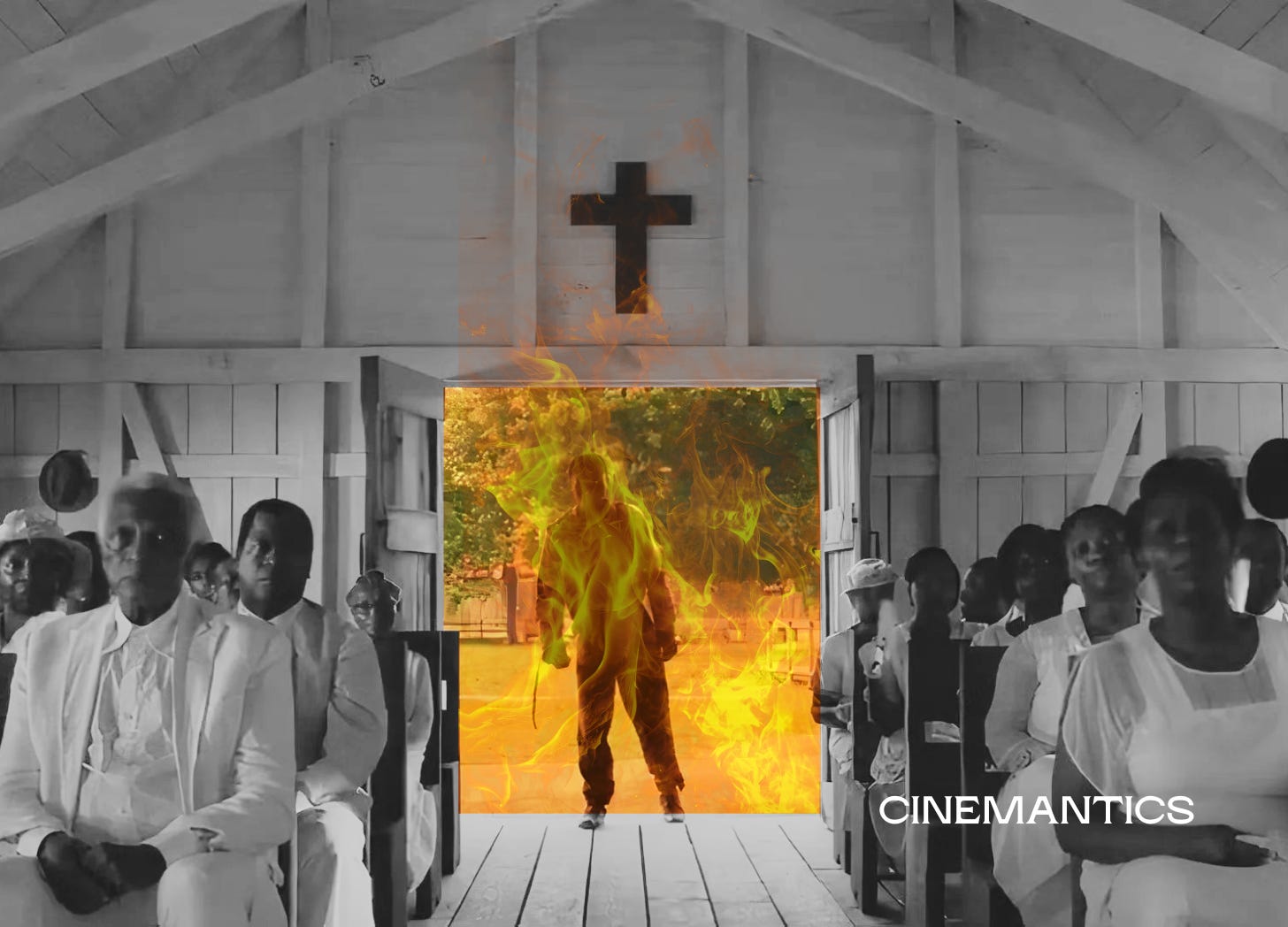
Throughout the exchange, every shot features a cross in the background, just out of focus, to emphasize the tension among the Church, the Blues, and Sammie.
Production designer Hannah Beachler told Variety that the three crosses in the church represent the Holy Trinity and are exactly 33 inches apart, alluding to the age Jesus died. The scene portrays Christianity as demanding the subordination of the individual to God, resulting in a loss of self, which Sammie is unwilling to sacrifice.
Holding the broken guitar neck against his chest, Sammie leaves his father, family, and faith to pursue his love of the Blues. I cannot praise the film’s careful and intentional visual storytelling enough. Every shot has a purpose. The film encourages and rewards careful analysis, but it does not require it to be enjoyed, which is the hallmark of any great movie.
At the end of Sinners, the lack of freedom in Christianity is starkly contrasted with the freedom found in the juke joint and the Blues. Decades after the fateful events at Club Juke, Sammie and Stack reunite and agree that it was the best day of their lives. “Just for a few hours,” Stack says, “we was free.” Some argue that the explicit critique of Christianity is tempered by the fact that Sammie’s radical individualism is not without consequence.
“Son, you keep dancing with the devil,” Sammie’s father warns, “one day he’s going to follow you home.”
The preacher’s words seem prophetic as everyone at Club Juke, except Sammie, is doomed to die or cursed to live as a vampire for eternity. They pay for their “sins” and the unrestricted, hedonic freedom they so deeply desire. In the end, even if Sammie rejects the faith, don’t the warnings of his father and Christianity prove to be true?
On the surface, it is a very reasonable conclusion. But that interpretation becomes increasingly difficult to hold when we see Christianity and vampirism portrayed as two sides of the same coin throughout the film.
The Church & Vampirism as Systems of Oppression
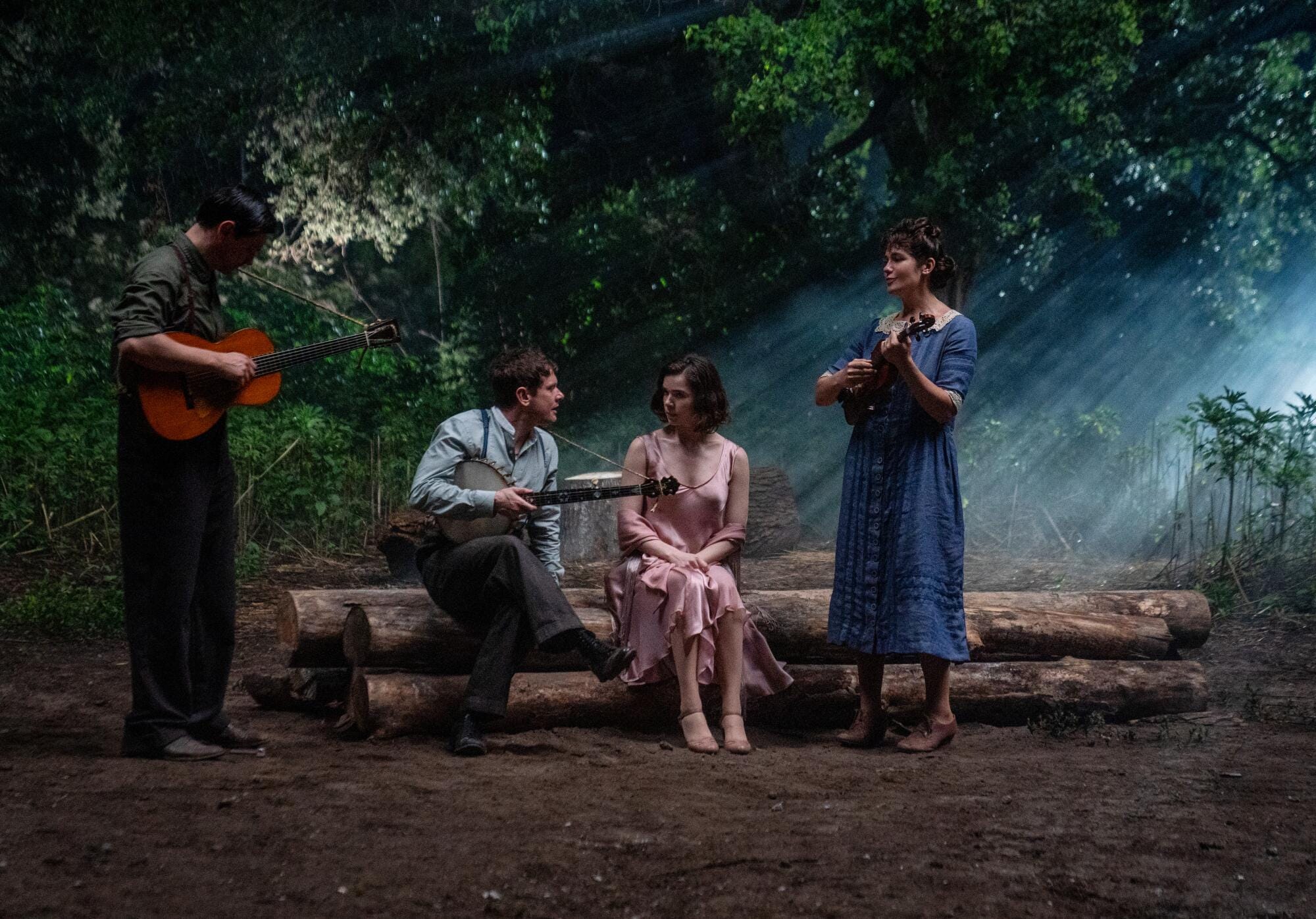
Christianity and vampirism have been portrayed as antithetical in art and literature, especially in classic vampire stories like Bram Stoker’s Dracula. Vampirism is a selfish inversion of Christian self-sacrifice. Count Dracula takes our blood so he might live, while Christ gives his blood so we might live.
Sinners turns this traditional understanding on its head by subtly suggesting there is no difference between Christianity and vampirism. The opening scene plants the seed.
When Sammie enters the church, bloody and scarred from the events of the night before, his father beckons him to come forward. As Sammie’s father extends his hand, there is an immediate cut to Remmick, the vampire leader, holding the same visual posture. Sammie’s gaze sweeps over the church’s congregation; a flashback replaces them with the congregating vampires we see at the end of the film.
From the outset of Sinners, there is an implicit comparison being made between Christianity and the oppressive, bloodsucking nature of vampirism. Delta Slim explicitly drives the point home when he says, “The blues wasn’t forced on us like that religion. Nah, son, we brought this from home.” Like a vampire, the Church carefully forces its “salvation” on unwilling victims through manipulation and, if necessary, violence.
Mary, a name that evokes the Virgin Mother of Christ, reveals the connection we are meant to see between the church and vampirism. Remmick tells Mary he can save her. “I’m sad, is all,” Mary replies, “I don’t need no saving.” Against her free will and choice, Remmick “saves” Mary by turning her into a vampire, a true believer. Like the Virgin Mother, Mary carries a vampiric salvation and eternal life within her, and she plans to share it with everyone at Club Juke.
However, she cannot walk into the juke joint without permission. She must be invited in, ideally without arousing suspicion of her motives. The need for an invitation plays upon an established vampire troupe while also evoking images of door-to-door evangelists asking to enter your home and tell you about the Good News.
After Mary convinces Cornbread to invite her into the juke joint, she seduces and violently “converts” Stack, forcing upon him an eternal life he never sought. When secrecy is no longer possible, Remmick openly tries to manipulate the remaining patrons of Club Juke into willingly becoming vampires because their fate is already sealed in death. Remmick reveals that the sawmill was intentionally sold to the Smokestack twins by the Grand Dragon of the Ku Klux Klan to lure blacks into a “killing floor.”
He does not offer protection from the evils of the world. Instead, he attempts to use the fear of suffering and death at the hands of bigoted whites to manipulate his victims into joining his vampiric cult.
Similarly, the Church cannot or will not save them from suffering and death. On the contrary, it calls them into suffering and death with the promise of eternal life in the world to come. Remmick suggests that religion is a baseless hope used to support a malevolent system of manipulation and oppression. Organized religion, particularly Christianity, might be a lie.
Remmick says, “Long ago, the men who stole my father’s land forced these words [the Lord’s prayer] upon us. I hated those men, but the words still bring me comfort. Those men lied to themselves and lied to us. They told stories of a God above and a devil below. And lies of a dominion of man over beast and Earth.”
Even if Christianity is true, its disciples abuse its teachings, using the fear of suffering and death and the hope for eternal life to manipulate and oppress others for selfish ends.
Sammie’s father spends his time in the church while his family and community pick cotton as sharecroppers. Remmick desires to appropriate Sammie’s ability to commune with his ancestors through music. Both use their position as arbiters of eternal life for personal gain.
Remmick offers an alternative to religious salvation, but the vampiric hive mind similarly requires the individual to disappear and become one with the collective. He proclaims, “We are earth and beast and God. We are woman and man. We are connected, you and I, to everything.” Sammie may live forever as a born-again Christian or a bloodsucking vampire, but he will lose himself and his ancestral heritage either way.
On the other hand, Blues and Hoodoo spiritualism offer a pseudo-afterlife by establishing and preserving one’s connection to ancestral “spirits from the past and the future.”
They provide fellowship and “bring healing to their communities” without placing demands upon the individual. Most importantly, they actually work.
Christianity is Powerless, but Blues & Hoodoo are Powerful
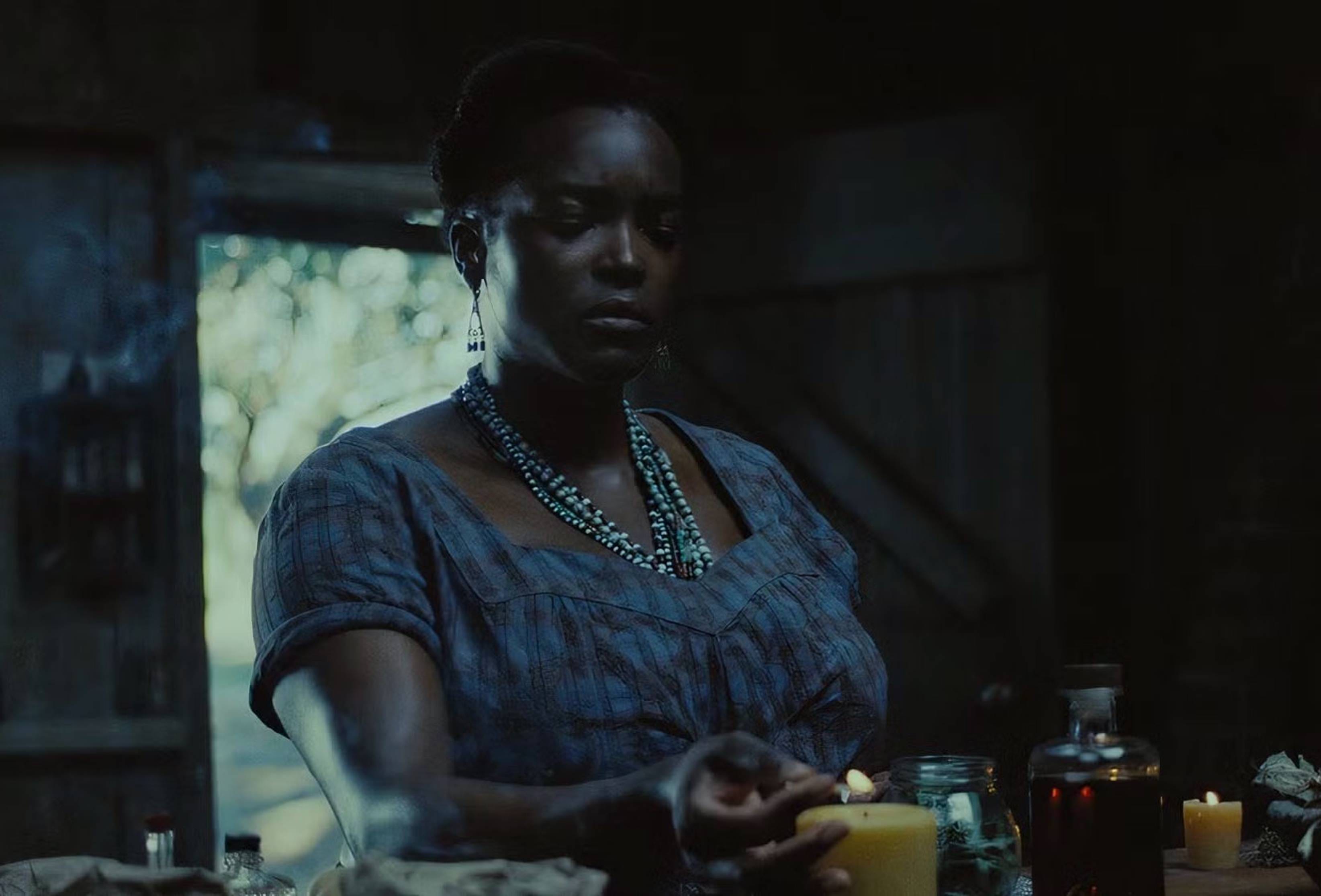
If the Church is merely another system of oppression, it follows that it has no spiritual power in reality. Sinners makes clear that the traditional Christian arsenal is useless against evil, suffering, and death. The Lord’s Prayer, the ultimate spiritual weapon in countless horror films, has no effect on Remmick. He even joins Sammie in its recitation. Deliverance does not come from the Word of God; it comes from Sammie’s guitar.
Hoodoo works where Christianity fails. A mojo bag protects Smoke from being turned into a vampire by his brother, Stack. Annie, who carries ancestral knowledge, becomes the only one who can help the group fight the vampires.
Even the afterlife is reframed.
After Smoke kills Hogwood, the Grand Dragon of the Ku Klux Klan, and the gang of white racists, he begins to die from a wound he received during the firefight.
While Remmick and the Church ignore and even participate in systems of oppression to further their selfish ends, Smoke directly confronts an actual threat to black existence, namely, white supremacy. He defeats the film’s real antagonists. Perhaps as a reward for his pure, genuine sacrifice, Smoke sees Annie, dressed in white, nursing their child in a kind of beatific vision.
Despite scoffing at the power of Hoodoo and his connection to the spirits of his people, Smoke is reunited with the souls of his deceased family. Meanwhile, Mary and Stack are cursed to linger as vampires, denied reunion with their ancestors.
Sammie’s fate is more ambiguous. He leaves behind everyone and everything, connecting to his roots only through the Blues, a tradition that, like any art form, risks losing its purity over time.
Clarifying the Unbalanced Critique of Christianity
For a film that derides moral absolutes, Sinners seems hellbent on presenting Christianity as an absolute moral evil. Christianity is presented as oppressive, manipulative, and powerless. However, two scenes help to clarify the critique. There is an explicit warning that Smoke gives Sammie about playing at juke joints for a living, and an implicit desire for reconciliation between the Church and the Blues in a post-credit scene.
After Sammie finishes his initial performance at Club Juke, Smoke tries to convince Sammie that playing at juke joints isn’t a good, happy life. “Well, you got the talent. That’s for certain,” he says, “but all this ain’t no life for nobody.”
Outside the Church, Smoke is the only character in the film to warn against the Blues and the culture around it. He does not say it is not a life fit for some; he says it is a life fit for no one. He continues, “You like makin’ music? Make church music. You wanna leave, go on down to Mound Bayou. Live with the proper Black folks. Leave all this here improper shit to us.”
When Sammie refuses to heed the warning, Smoke threatens to kill his cousin if he finds him playing at another juke joint. While Smoke is not directly advocating for the Church, he similarly judges and condemns Delta Blues and its culture, suggesting there is some truth and, at least, practical wisdom to its teachings.
Playing Blues at juke joints as a lifestyle lacks true community, the kind of community Smoke recommends Sammie find at Mound Bayou. Blues and its culture offer a semblance of human community and fellowship, not their realities. Smoke acts as a counterbalance to the instability of not only the Blues but also other unstable elements in the film, such as his twin brother.
In addition to their clear difference in personality and mannerisms, the twins are starkly contrasted in color, representing the proper tension between themselves and the world throughout the film. Smoke is dressed in blue, while Stack is dressed in red, a color he shares with the atmosphere of the juke joint.
It is essential to see the constant balancing act at every level of the film, because it is a pattern we expect to find between Christianity and the Blues, but it is never fully realized.
Sinners is not anti-Christian in the blunt, reactionary way some critics suggest. Its critique of Christianity, particularly its relationship to Delta Blues and Black cultural expression, is far too thoughtful to be dismissed as propaganda. Coogler understands the importance of the Church, just as he understands the power of the Blues. He and his team stage their conflict with extraordinary creativity.
In an interview with the Grio, Coogler described Sinners in these terms:
“It has to do with that relationship that Delta Blues has with its kinda like twin sibling, gospel music.”
Blues music was the first American music to be referenced as the devil’s music. That judgment of the practitioners of the music and folks who engage in the culture around it is at the heart of this movie. That conversation and acknowledgement that we all are [sinners] and if you point the finger at somebody calling them a sinner, you also have to point the finger back to yourself.
Even the most religious person would admit that they’re a sinner; everybody is. It’s a term of judgment, but it’s also a term that’s welcoming as well. [In a] Christian context, that’s who Jesus spent the most time with.” But understanding tension is not the same as sustaining it.
If Sinners is truly about the balance between gospel and blues, restraint and release, Smoke and Stack, holy water and blood, then that balance ultimately collapses under the film’s own moral gravity. Christianity is given weight as an institution and as a historical force, but it is never granted real spiritual efficacy or moral defense.
Gospel music never heals, never saves, never meaningfully competes with the power of the Blues. The Church is acknowledged, but lacks vitality in the film. It exists primarily as an undefined structure of control, fear, and negation. That imbalance matters because it lessens the tragedy of Sammie’s choice. His struggle should feel agonizing, an authentic tearing between two living, breathing worlds.
Instead, the scales are tipped so decisively that his departure from the Church feels less like a loss and more like an inevitability. The film tells us he is choosing between faith and freedom, but it shows us freedom on one side and suffocation on the other. What should be a genuine spiritual dilemma becomes, in the final analysis, a predictable exodus.
And yet, Sinners is bold enough to hesitate. In the post-credit scene, it gestures toward something unresolved, something still aching. Sammie’s blues-inflected performance of This Little Light of Mine in his father’s church does not redeem Christianity, but it refuses to erase it.
It acknowledges that for Black Americans, the sacred and the profane have never been cleanly separated. The Church has wounded, but it has also healed. The Blues has liberated, but it has also unmoored. To borrow Sammie’s words, “I’m full of the blues, Holy water too.”
Sinners ultimately insists that salvation cannot be inherited, enforced, or imposed by fangs or by crosses. It must be chosen. However, by denying Christianity any real counterweight to the spiritual power of Blues, the film makes that choice feel less significant than it should. Gospel and Delta Blues are more like estranged relatives, and less like the twin siblings Coogler envisions.
The question is not whether Sinners condemns Christianity, but whether it allows it enough life to truly matter. That unresolved tension between what the film understands and what it ultimately affirms is not a failure of intent but a limitation. One that keeps Sinners from fully embodying the very balance it so brilliantly imagines.
Sinners is now available for purchase on physical media and for streaming on HBO Max. Rated R for strong bloody violence, sexual content and language.
Best thing we've published in a while. Provocative and engaging. Great stuff!