


This piece was originally published on July 9th, 2026, on “Art Life Balance.”
My (Gen Z) brother was hyping up the movie “Backrooms” long before it hit theaters. A big fan of the YouTube series and ascendant “liminal space” genre of horror — and an enthusiastic participator in hype cycles — he would regularly pepper our phone calls with fun facts about director Kane Parsons and proclamations that this would be an INCREDIBLE FILM (yes, he called it a film), occasionally texting me “backrooms backrooms” just in case I didn’t get the memo. Naturally, this made me incredibly disinclined to see it.
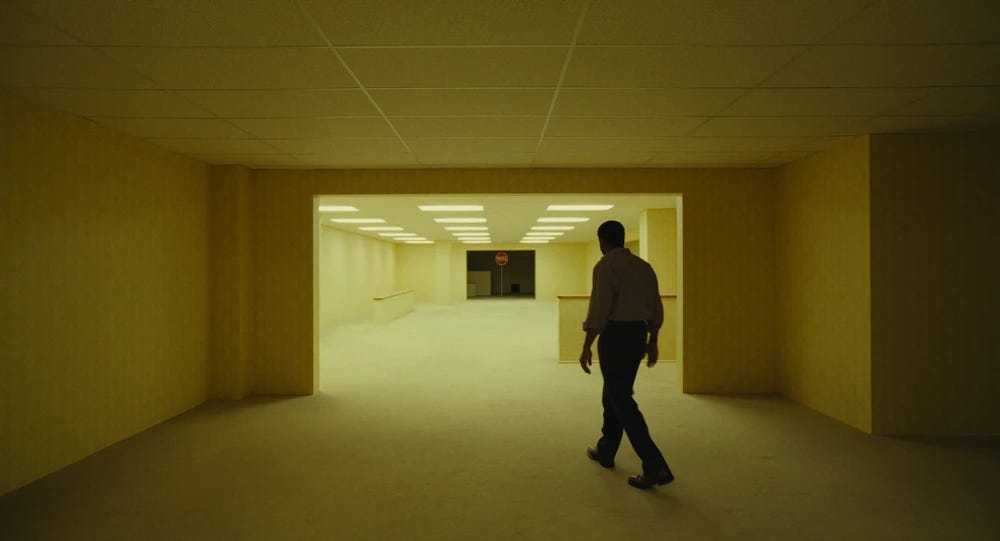
However, I happened to be visiting my other brother (also Gen Z) on the movie’s opening weekend. He, having fallen victim to the same grassroots PR campaign, was kind of interested. So, as fate would have it, I found myself in a crowded theater on a Saturday night in rural Indiana watching “Backrooms,” a movie about a sad furniture salesman who walks through a wall into a hidden universe of maze-like spaces filled with familiar but dissembled objects, all bathed in the sickly glow of florescent light.
I must admit: It was great. A rare movie whose themes stuck with me long after leaving the theater.
The main character of the movie, a wannabe architect and real-life cheap furniture salesman named Clark (Chiwetel Ejiofor), is a case study in stagnation. In one of the first scenes of the movie, we see him dressed as a pirate in a commercial for Cap’n Clark’s Ottoman Empire before sitting on a chair that breaks on impact. What at first is comic becomes just plain sad when we discover that Clark not only works but sleeps in the furniture store, never leaving the environment that is a physical manifestation of his failure to launch. We do see him visit a therapist named Mary (Renate Reinsve), who, as we later learn, struggles to process her own past, but even here, there’s no forward momentum: It’s implied that Clark was abusive to his ex-wife but is unable to take responsibility for his role in their split; instead, he replays old events without learning anything from them.
The horror in “Backrooms” lies not only in the uncertainty about what might exist there, but also in the lack of clarity about whether the space operates by any consistent set of principles.
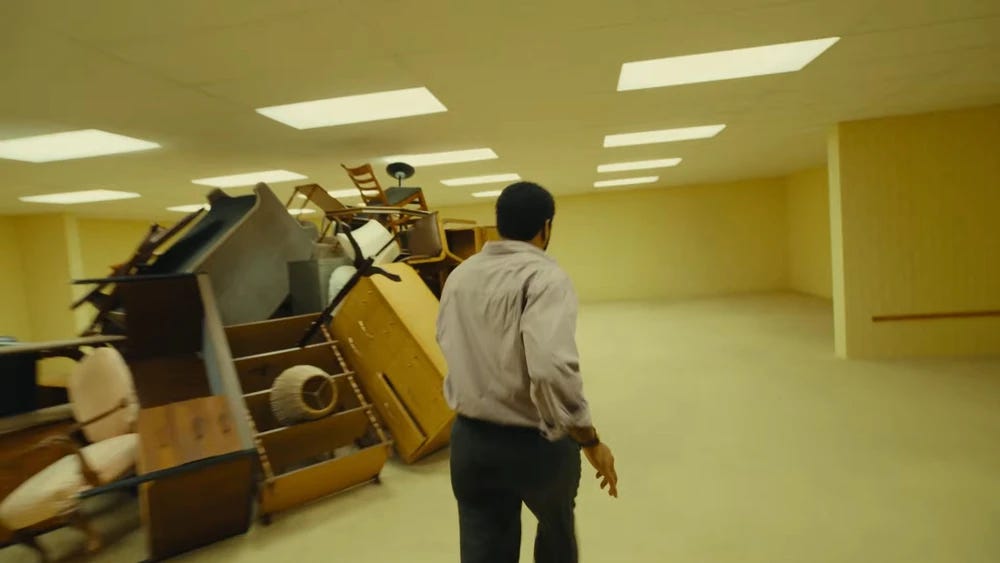
Dull sadness gives way to horror when Clark enters the backrooms, a seemingly endless series of spaces reminiscent of Clark’s own experiences but warped and decontextualized. In one room sits a pile of furniture, similar to items in Cap’n Clark’s but haphazardly thrown together for no apparent reason. In a hallway hangs an advertisement half eaten by the wall. Still other spaces contain items we’ve never seen Clark interact with in the outside world: some generically familiar, like a STOP sign; others, not so much, like a cardboard cutout of a caveman equipped with a speaker. The horror in “Backrooms” lies not only in the uncertainty about what might exist there, but also in the lack of clarity about whether the space operates by any consistent set of principles.
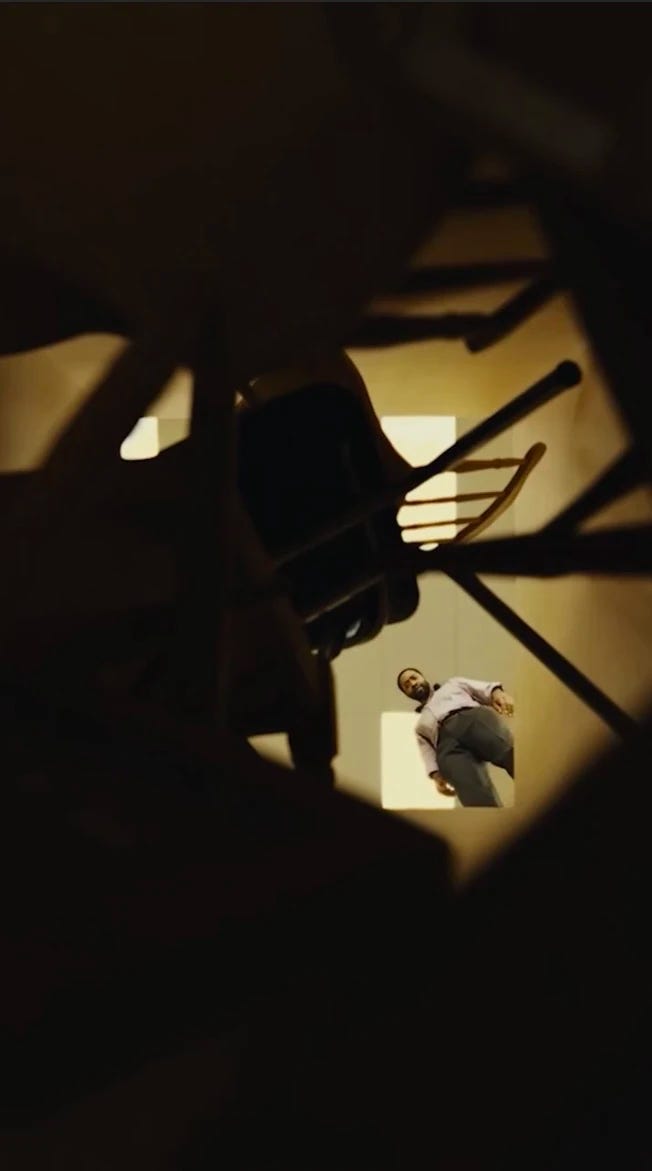
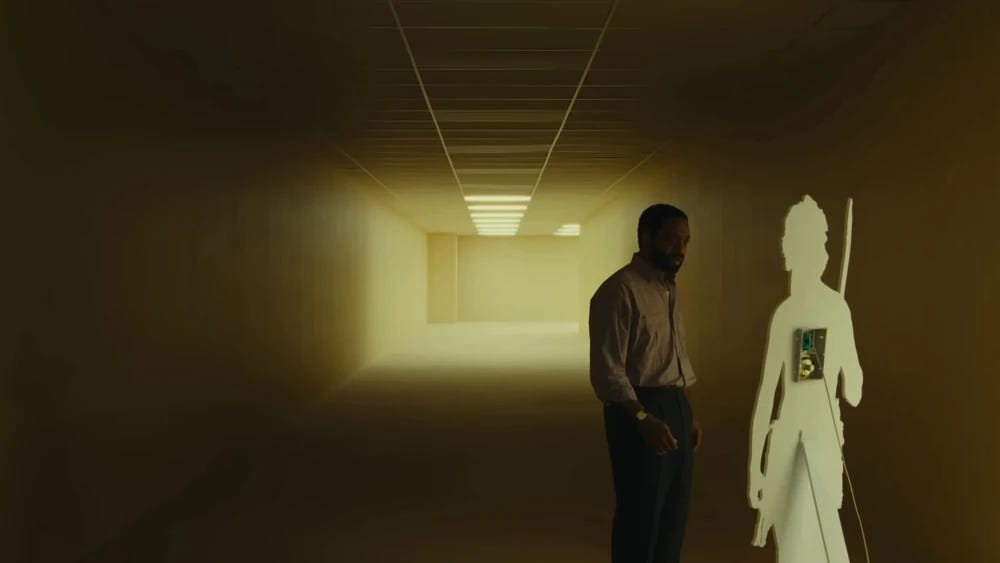
As more characters journey into the Backrooms, we ultimately get the fuzzy sense that the space is some sort of unconscious replication machine, populating itself with “new” forms based on the memories, experiences, and emotions of those who enter it. But no replication ever perfectly matches the original. Like a game of telephone or a memory of a memory of a memory, each iteration becomes less specific and more garbled as the Backrooms “re-remembers” it and merges it with other ideas. One of the creepiest visual manifestations of this concept is the “furniture people,” human-object hybrids that Clark, and eventually Mary, find stumbling around aimlessly or vegetating among the objects. Half-alive and barely aware, their very nonthreatening-ness only adds to our unease.
It’s not hard to read the Backrooms and the derivative objects it generates as a representation of Clark’s mental state. Failing to move toward a greater understanding of his present, Clark is trapped in the past. What “Backrooms” captures impeccably is that even stagnation is not truly stagnant. Failing to move forward is a choice with consequences: In Clark’s case, it means becoming a low-resolution caricature (the garish pirate costume, sleeping in the store, the gap between dreams of architecture and a reality of shoddy furniture), a copy of a copy of a copy of himself. In this context, Clark’s eventual admission that he feels comfortable in the Backrooms and doesn’t want to change is perhaps the most disturbing moment of all because it forecloses the possibility of growth, guaranteeing further degradation.
“We are listening to our slightly off data double.”
Compelling interpretations of “Backrooms” are as endless as the space itself — ranging from the psychological effects of trauma to the pitfalls of nostalgia to the ravages of time on memory — but I do have a theory about why the movie resonates so deeply with Gen Z in particular. The first generation to grow up online, tethered to social media and algorithmically curated streaming services increasingly populated with derivative AI content, Zoomers know firsthand what it’s like to spend time in alternate universes that serve up slightly “off” versions of themselves. Through personalized newsfeeds, recommendations, and filtered and decontextualized text and images, they traverse environments that feel both familiar and inert, lacking the challenges necessary for change.
Journalist Liz Pelley explores this phenomenon in her recent book “Mood Machine,” examining how design initially informed by user behavior eventually begins to shape it, making people more manipulable.
“We are listening to our slightly off data double,” she writes of the experience of listening to music on Spotify. “But at a certain point, a streaming listener may very well come to believe that what the machine suggests is indeed what they like, not because it’s true but because they can see or feel no other option.”
Austrian philosopher and theologian Ivan Illich put it this way in the mid-90s (perhaps he was influenced by the sterile aesthetic of real-life backrooms or the tepid tones of Muzak?): “We submit ourselves to fantastic degradations of image and sound consumption in order to anesthetize the pain resulting from having lost reality.”
“Not because it’s true.” “Having lost reality.”
These snippets pinpoint what makes “Backrooms” so eerily familiar in the age of algorithms, when so many of us have become more comfortable scrolling filtered memories online than making new ones in the physical world. The movie asks us to consider whether we do this not despite, but because of the fact that these experiences are less real. Further, it suggests that those who explore the Backrooms (proverbial or otherwise) should take seriously the nagging suspicion that something monstrous lurks within, because the more time we spend there, the more likely it is to become actualized.
Once we’re that far gone, is escape even possible? It depends on whether we “see or feel no other option.”
Art Life Balance, a human-generated newsletter by Talia Barnes, is about media, culture, and the creative process. All posts are free to read, but if you’d like to support the newsletter (and get a little something in return), become a paying subscriber and join Print Club to receive art in the mail every season.
