


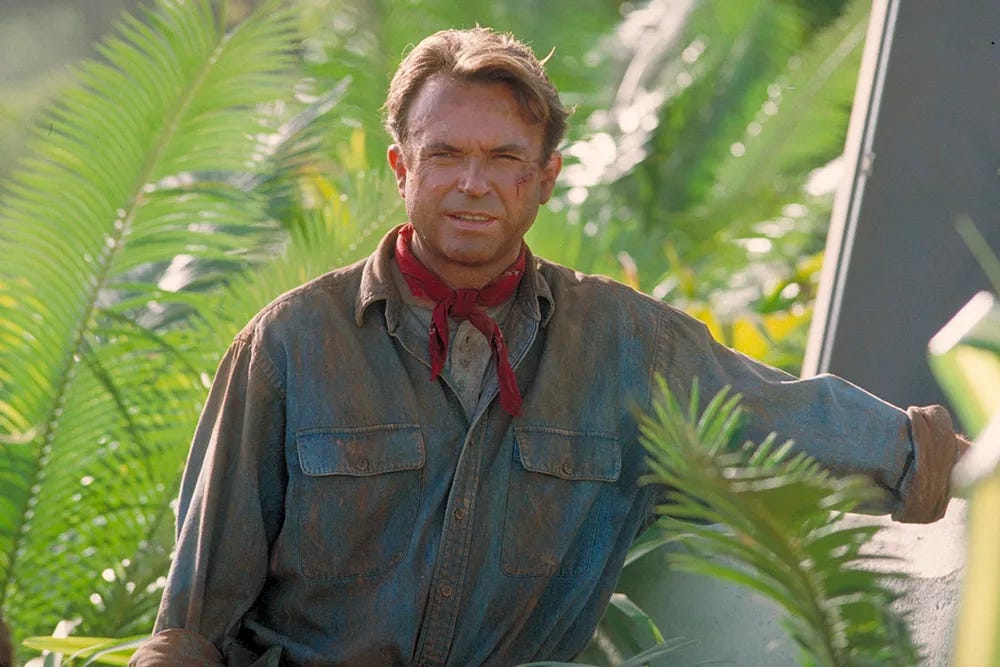
There are many visually striking moments that could define Sam Neill’s career.
Alan Grant removing his glasses in awe of a Brontosaurus in Jurassic Park. A deformed Dr. Weir embracing his union with the titular ship in Event Horizon. Or his protagonist in John Carpenter’s final masterpiece In The Mouth of Madness watching the prior events of the film play out on the movie screen in front of him.
Neill, who passed away on July 13, is likely best known for his role as Alan Grant in the Jurassic Park series. Much of his career was made by playing the leads in horror cult classics, from the aforementioned ‘90s science fiction-horror hybrids to the third Omen film and 1981’s Possession early in his career. Alternatively, he played important supporting roles in dramas like The Hunt for Red October and The Piano.
Co-stars and friends have been effusive with testimonials about what a pleasure Neill was to work with. And he took on a charmingly wholesome presence on social media.
That off-screen persona often clashed with Neill’s starring performances. He played arrogant, deranged, and sometimes monstrous characters, and he thrived at selling the outlandish horror rules he took on. But Neill could also play humble and was modest enough to embrace smaller roles. Not smaller in importance, but in emotional scope.
He approached every role with a humanity that meant that he never took over or carried a film on his own. And yet he was consistently the most important part of the emotional core of his movies.
For example, if Jeff Goldblum’s Ian Malcolm was the moral voice of Jurassic Park with his condemnation of John Hammond’s attempt to play God, Neill’s Grant was the heart. The emotional arc of the film hinges on one moment, after the T-Rex paddock set-piece, when Grant begins his transformation into a paternal figure. “He left us, he left us!” Lex cries hysterically, referring to a character who abandoned the children to the T-Rex. “But that’s not what I’m going to do,” Grant reassures her.
It’s an understated but firm delivery. It’s also the moment when Grant begins his transformation into a father figure who will guide the children, and the audience, through the park back to safety. Neill needs to sell both the awe of seeing live dinosaurs for the first time, and also that an aloof, distant scientist could become a warm, protective figure. He nails both aspects of the role. His performance gives the movie its core and sells the dinosaurs to the audience. And Neill is so good in the role precisely because he gives Grant such a clear character arc while also being game to play a part in an ensemble cast.
Neill was never quite a movie star. His leading roles are mostly relegated to cult horror classics. But he always brought a pathos to every character he played, no matter how over-the-top. And he demonstrated a versatility by spanning different genres while never losing that humanity in each of his characters.
His performance as a doomed Russian officer, for example, in Red October is heartbreaking. His delivery of “I would have liked to have seen Montana,” would be a throwaway moment for a lesser actor. In Neill’s hands, it elevates the emotional stakes of the film. He makes the moment way more affecting than it has any business being. That was his power as an actor. No role was too small for him.
Rest in peace, Sam Neill. There truly was no one better to guide us children through Jurassic Park.